

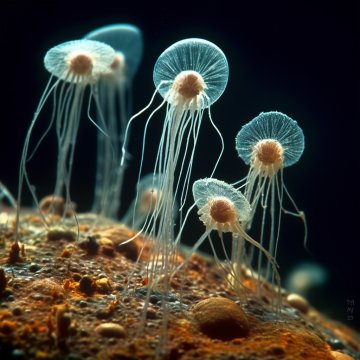


Friends ANBG will be among the first to hear Jochen, from the ANU, talk about the evolution of modern eurkaryotes, the “Rise of Algae”, in the body and molecular fossil records; and how it may be a most profound ecological transition in the evolution of complex life, ultimately leading to the emergence of animals.
Abstract
In the 1994 essay ‘Evolutionary Perfection of a Small Molecule’, Nobel Laureate Konrad Bloch suggested that small molecules, such as sterols in the membranes of nucleated cells, may have evolved from more simple ancestor molecules. He had the (back then) crazy vision that it might be possible to find such primordial ‘ur’-sterols in the ancient rock record, thus proving the idea of molecular evolution. However, Bloch was reportedly not really hopeful that such molecules could really ever be preserved or discovered.
In the Botanical Gardens, you will be among the first to hear that that such fossil molecules are abundantly preserved in sedimentary rocks up to 1.6 billion years old. The detected fossil fat molecules represent two steps in the biosynthetic pathway towards modern eukaryotic sterols (such as cholesterol) and appear to be witnesses of a lost world of ancient stem-group eukaryotes that were widespread and possibly abundant during Earth’s middle age (1.8 to 0.8 billion years ago). Our crown-group eukaryotic relatives must have co-existed with those primordial organisms for several hundred million years, unable to invade their niches. With rising atmospheric oxygen levels and changing marine chemistry, crown-group Eukarya, including the algal ancestors of land plants, started to expand and replace the Protosterol Biota ~1,000 to 800 million years ago. This shift to modern eukaryotes, the ‘Rise of Algae’, is recorded in the body and molecular fossil records and may be one of the most profound ecological transitions in the evolution of complex life, ultimately leading to the emergence of animals.
Biography
Jochen Brocks is a professor of palaeobiogeochemistry at the Research School of Earth Sciences, Australian National University. He is fascinated by arcane biological processes in Precambrian oceans, the early evolution of eukaryotes and the emergence of the first animals. To find clues about ancient life, he studies molecular fossils of biological lipids (biomarkers) that can be preserved in sedimentary rocks for billions of years.
Bookings open on 9 May at https://www.trybooking.com/DALER